NASA's SkyFall helicopters to ride the SR-1 Freedom nuclear spacecraft to Mars
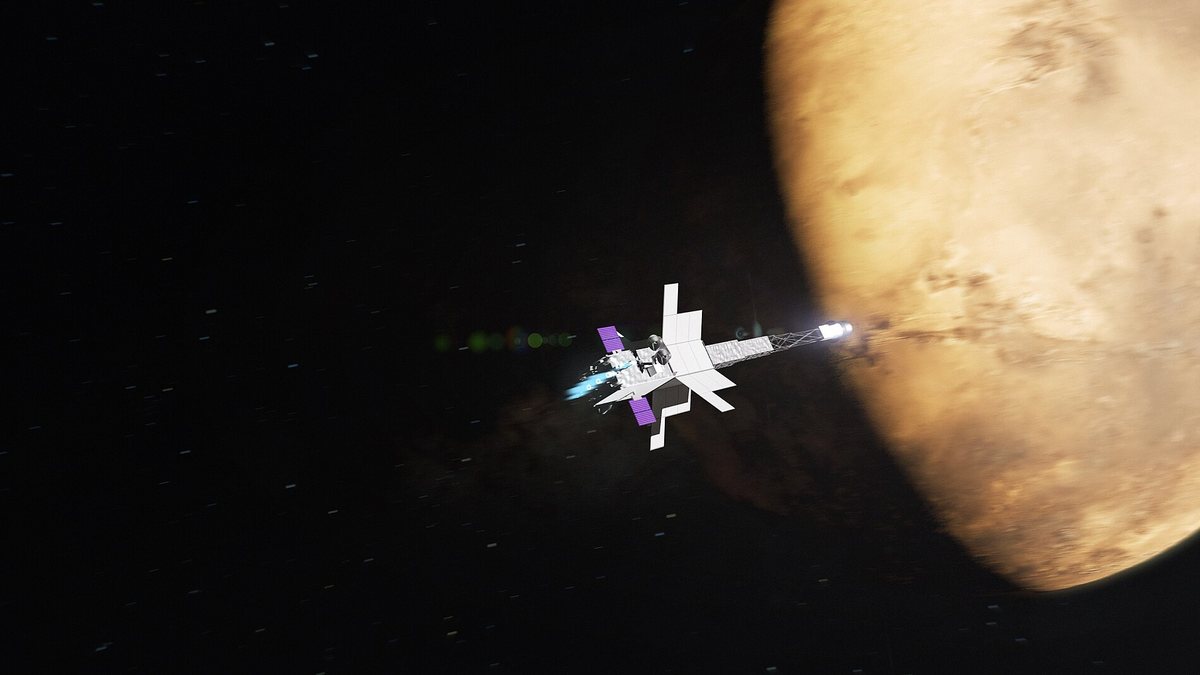
NASA’s SkyFall mission is now planned to send three Ingenuity-class helicopters to Mars aboard Space Reactor-1 Freedom (SR-1), the agency’s first fission nuclear-powered interplanetary spacecraft, with launch targeted for late 2028. Under the current plan the carrier would make an initial Mars flyby in 2029 and a second approach in fall 2030 to release a SkyFall entry capsule; the helicopters would then spin up their rotors about a kilometer above the surface, land separately, and fly roughly every other sol. SkyFall project scientist Matthew Golombek of NASA’s Jet Propulsion Laboratory told the Mars Exploration Program Analysis Group on Nov. 10 that the project, started in March 2026, has grown from about six people to more than 200, with a six-month prime mission and a one-year goal built around a ground-penetrating radar to find subsurface ice layers and buried rock. The architecture is a plan rather than a demonstrated capability, and Scott Hubbard, former director of NASA’s Ames Research Center and the agency’s first Mars program director, told Space.com the pairing looks like a “shotgun marriage” in which a technology demo piggybacks on another mission, and questioned whether SR-1 will be ready for the 2028 window.
Verified and unconfirmed
- Verified: JPL’s Matthew Golombek, speaking at the Nov. 10 MEPAG meeting, described the SkyFall plan — three helicopters released about 1 km above Mars, landing independently, flying every other sol, a six-month prime mission with a one-year goal, and an identical five-instrument payload on each vehicle led by a flexible-antenna ground-penetrating radar — and said the project has grown from roughly six people to over 200 since NASA initiated it in March 2026.
- Not yet confirmed: that SR-1 Freedom will be ready for the late-2028 launch window, or that the 2030 capsule release and helicopter deployment sequence will work; no firm launch date, cost figure, or independent assessment of the nuclear spacecraft’s schedule has been released, and Hubbard’s “shotgun marriage” criticism is one expert’s opinion rather than an official finding.
Background
SkyFall grew out of Ingenuity, the small helicopter that flew on Mars as a technology demonstration; Scott Hubbard, a former director of NASA’s Ames Research Center and NASA’s first Mars program director, says the concept was intended as a follow-on that would turn a demo into a science platform. NASA kick-started the SkyFall project in March 2026, and according to project scientist Matthew Golombek it has expanded from about six people to more than 200. The carrier, Space Reactor-1 Freedom, is described as the first fission nuclear-powered interplanetary spacecraft — a nuclear electric propulsion (NEP) design in which a reactor generates electricity to drive thrusters — and Hubbard questions whether it will be ready for the 2028 Mars launch window.
Why it matters
The spacecraft choice is driving the science: Hubbard says the usual sequence is reversed, with the science community “having to scramble to back into a set of requirements and objectives that match the SkyFall capabilities,” so researchers proposing Mars precursor studies should expect to fit the decadal survey’s broad objectives to a fixed five-instrument payload rather than to a purpose-built mission. The same coupling carries schedule risk for the planetary program, since Hubbard says the Mars program has “a standard launch concept in their back pocket” if the nuclear carrier is not ready in time.
What to watch
The late-2028 Mars launch window is the gating date: watch whether SR-1 Freedom’s development schedule holds to it, or whether NASA falls back to the conventional launch option Hubbard describes. NASA has not published a firm launch date or a decision point for that fallback.

Comments
Comments use a GitHub account and are moderated. Comment rules