Hera returns first close-up of the stadium-sized crater DART punched in Dimorphos
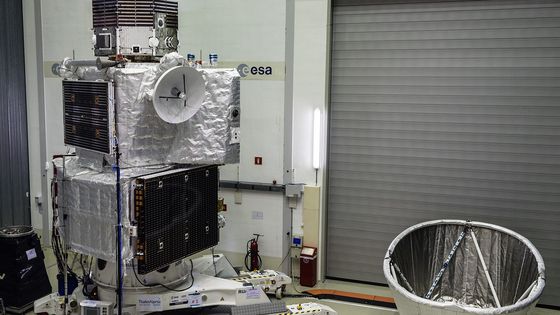
The European Space Agency’s Hera spacecraft has sent back the first close-up views of the scar left by NASA’s DART impact on the asteroid moonlet Dimorphos, showing that the September 2022 collision flattened one entire face of the moonlet into a crater spanning its full width, set it tumbling chaotically, and apparently blasted out hundreds of previously unknown boulders a few meters across that now circle the Didymos system. Hera, launched in October 2024, made the 194-million-kilometer (120-million-mile) trip and is holding a rectangular orbit about 30 kilometers (18.6 miles) from the binary asteroid. ESA presented the images on Wednesday, Nov. 25, at Berlin’s Museum für Naturkunde. Regions of Dimorphos outside the impact zone look the same as they did in DART’s 2022 images, ESA says. Telescopes had already shown that DART lengthened Dimorphos’s orbit around Didymos by about 33 minutes; Hera’s job is to show what happened to the asteroid itself.
Verified and unconfirmed
- Verified: ESA presented Hera images on Nov. 25 showing a crater covering the whole face struck by DART, a moonlet tumbling erratically in its orbit, hundreds of small orbiting boulders, and unchanged terrain on the unimpacted side, according to Hera principal investigator Patrick Michel and ESA mission scientist Michael Kueppers.
- Not yet confirmed: the crater’s precise dimensions, the boulder count and the tumbling rate rest on ESA’s interpretation of images released at a press event, with no peer-reviewed paper cited; Dimorphos’s mass and internal structure — which Hera’s CubeSats are meant to measure — remain unknown, and the report gives no dates for Hera’s closer approach or the CubeSat deployments.
Background
NASA’s DART probe struck Dimorphos, the small moonlet orbiting the larger asteroid Didymos, on Sept. 26, 2022, in a test of whether a kinetic impact could deflect an asteroid headed for Earth. Because the impact destroyed the spacecraft, astronomers could initially judge the result only from Earth-based telescopes, which measured that Dimorphos’ roughly 12-hour orbit around Didymos had shortened by about 33 minutes — far more than predicted. ESA’s Hera mission, launched in October 2024, was sent to the same system to survey the aftermath directly, a journey of about 120 million miles (194 million kilometers).
Why it matters
Deflection planning needs Dimorphos’s mass: combined with the measured 33-minute orbital shift from DART, it lets mission designers calculate how much momentum an impactor actually transfers to a rubble-pile asteroid, which is the number needed to size a real planetary-defense mission rather than guess at it. Hera’s CubeSats are intended to supply that mass measurement directly.
What to watch
Hera will next close to roughly 13 kilometers (8 miles) for sharper imaging, then release its two shoebox-sized CubeSats: Juventas, which will use low-frequency radar to probe an asteroid’s interior for the first time and later attempt a landing to measure Dimorphos’s gravity, and Milani, which will survey dust and surface material around the Didymos system.
Coverage of this story
- 2026-11-25 · Space.com: Watch live: Europe unveils 1st close-up views of asteroid Dimorphos after NASA’s DART impact
- 2026-11-25 · Space.com: Hera spacecraft gets 1st up-close look at stadium-sized hole punched in asteroid by NASA DART mission
- 2026-11-25 · Ars Technica: European spacecraft finds chaotic scene after asteroid deflection experiment
Comments
Comments use a GitHub account and are moderated. Comment rules